
Business Automation Solutions in Nigeria: How to Improve Efficiency, Visibility and Growth
Business Automation Solutions in Nigeria: How to Improve Efficiency, Visibility and Growth
 Lagetronix
Business automation solutions in Nigeria are helping organisations replace repetitive manual work, disconnected spreadsheets, paper-based approvals and fragmented applications with connected digital processes.
For Nigerian SMEs and growing enterprises, automation is not simply about buying software. It is about creating a more organised business—one in which information moves quickly, approvals are traceable, customers receive timely responses and management can see what is happening across finance, sales, inventory and operations.
Nigeria’s digital economy is continuing to expand. GSMA reported that the mobile sector contributed 13.5% of Nigeria’s GDP in 2023 and described connectivity as the foundation on which digitalisation is built. Meanwhile, NITDA’s 2024–2027 roadmap prioritises digital infrastructure, cybersecurity, innovation, skills and the automation of critical organisational processes.gsma
What Is Business Automation?
Business automation is the use of software, integrated systems, workflow rules and digital platforms to perform recurring tasks with reduced manual intervention.
It can be as simple as automatically notifying a manager when a purchase request needs approval. It can also involve an enterprise resource planning system that connects accounting, inventory, procurement, sales, manufacturing and management reporting.
Microsoft describes workflow automation as a way to connect applications and services so organisations can synchronise files, collect data, issue notifications and manage approvals. Microsoft’s business-process guidance also covers end-to-end activities such as prospect-to-quote, order-to-cash, source-to-pay, plan-to-produce, inventory-to-deliver and record-to-report.microsoft
The purpose is not to remove people from the business. Effective automation removes avoidable repetition and gives employees more time to solve problems, serve customers, analyse information and make informed decisions.
Why Business Automation Matters in Nigeria
Nigerian businesses operate in an environment where cost control, speed, accountability and resilience matter. A 2024 GIZ/Digital Transformation Center Nigeria study involving 1,811 MSMEs across ten states found that 72% identified increasing operating costs as a significant challenge, 59% cited inflation, 48% mentioned access to finance and 41% reported electricity or blackout challenges.dtcnigeria+1
The same study found that approximately 80% of respondents believed innovation and technology could help address business challenges. However, affordability, limited knowledge, connectivity and access to expert guidance continued to affect adoption. About 59% of the surveyed businesses did not have internet connectivity, reinforcing the need for solutions that fit each organisation’s infrastructure and digital maturity.dtcnigeria
This means Nigerian companies should avoid copying an automation model simply because it works elsewhere. They need systems selected around their actual processes, connectivity, workforce, operating locations, security requirements and budget.
Common signs that a business needs automation
Your organisation may be ready for automation if:
- Employees repeatedly enter the same information into different spreadsheets.
- Stock levels are difficult to confirm without calling the warehouse.
- Financial reports take too long to prepare.
- Customer enquiries are lost between email, telephone calls and WhatsApp.
- Purchase, leave or expense approvals depend on physical documents.
- Management lacks real-time information on sales, cash flow and operations.
- Payroll calculations or payslips are largely manual.
- Teams cannot easily locate the latest version of a contract or document.
- Branches maintain separate records that require manual consolidation.
- Business performance depends heavily on one employee’s personal files or knowledge.
These pain points align with Lagetronix’s internal market analysis, which identifies manual production, inventory, quality control, project, payroll, customer-service and supply-chain processes as important automation opportunities. It also identifies the need for real-time reports, application integration, remote access and stronger regulatory control.
The Most Relevant Business Automation Solutions in Nigeria
There is no single application that is suitable for every organisation. The appropriate solution depends on the size of the business, industry, existing technology, number of locations and complexity of its processes.
| Automation category | Processes it can support | Potential business outcome |
|---|---|---|
| Workflow automation | Approvals, notifications, task assignment and escalation | Faster turnaround and clearer ownership |
| ERP systems | Finance, procurement, inventory, projects and manufacturing | Connected data and stronger operational control |
| CRM solutions | Lead management, quotations, follow-up and customer service | Better customer visibility and consistent engagement |
| Finance automation | Invoicing, receivables, reconciliation and reporting | Faster reporting and improved financial control |
| Inventory automation | Stock movements, replenishment and warehouse reporting | Better stock accuracy and availability |
| Document management | Capture, storage, retrieval, routing and approval | Reduced paper dependence and easier access |
| HR and payroll automation | Employee data, leave, attendance, payroll and appraisal | More consistent HR administration |
| Customer-service automation | Ticketing, routing, reminders and status updates | Faster and more accountable support |
| Analytics and reporting | Dashboards, KPIs and scheduled management reports | Improved decision visibility |
| Industry-specific systems | Education, healthcare, membership and tax workflows | Automation aligned with sector requirements |
1. Workflow and Approval Automation
Workflow automation is ideal for processes that follow predictable steps. Examples include purchase requests, vendor onboarding, expense approvals, document reviews, leave applications and service escalations.
Microsoft business process flows can guide users through defined stages, require important information before progression and help employees follow consistent steps. This can support standardisation and reduce the training burden for recurring processes.microsoft
For a Nigerian business, useful starting workflows may include:
- New-customer onboarding
- Purchase-order approval
- Automated invoice reminders
- Sales-lead assignment
- Complaint escalation
- Contract-review routing
- Daily or weekly management reports
2. ERP and Financial Management Automation
ERP solutions connect important business functions in one structured system. Instead of keeping finance, inventory, purchasing and sales in separate files, an ERP creates a shared operational record.
Lagetronix’s ERP portfolio includes Sage 300, Sage X3 and Microsoft Dynamics 365 Business Central. Its internal product framework identifies finance, accounts payable and receivable, fixed assets, budgeting, consolidation, inventory, procurement, manufacturing, project costing, dashboards and business intelligence among the available implementation areas.
ERP may be appropriate when a business:
- Operates multiple branches or warehouses
- Needs stronger inventory and procurement control
- Has outgrown standalone accounting software
- Requires manufacturing or project-costing functionality
- Spends significant time reconciling departmental records
- Needs audit trails and management dashboards
- Wants finance and operations to work from connected information
The goal should not be to automate a poor process exactly as it exists. Before implementation, organisations should review unnecessary steps, duplicated approvals and inconsistent data.
3. CRM and Sales Automation
A customer relationship management system organises leads, customers, quotations, interactions and service history.
CRM automation can help sales teams capture enquiries, assign account ownership, schedule follow-ups, monitor opportunities and maintain customer information beyond individual email accounts or mobile phones.
Lagetronix’s internal marketing plan identifies customer tracking, sales forecasting, quotation delays, marketing automation, after-sales feedback and real-time performance reporting as common CRM opportunities.
For management, a CRM can provide better answers to questions such as:
- How many prospects are in the pipeline?
- Which quotations require follow-up?
- Where do the strongest leads originate?
- Which customers have unresolved issues?
- What is the status of each sales opportunity?
4. Document Management Automation
Paper documents and unstructured shared folders make information difficult to find and control. Document management systems can support digital capture, indexing, retrieval, version control, routing and approval.
Lagetronix provides DocuWare document management implementation to digitise and streamline document-centred workflows. This can be relevant to finance departments, legal practices, HR outsourcing companies, educational institutions, construction businesses and organisations with audit-intensive records.
Document automation may cover invoices, contracts, employee records, purchase requests, project documentation, customer files and regulatory evidence.
5. Inventory and Supply-Chain Automation
Inventory automation helps businesses record stock movements, monitor availability and improve replenishment decisions.
Lagetronix offers ERP-connected inventory functionality and RFID inventory solutions. Its company materials describe RFID implementation as a way to automate inventory tracking and improve accuracy and efficiency.
This is especially relevant to manufacturers, distributors, retailers, healthcare organisations, logistics companies and multi-warehouse operations.
6. HR and Payroll Automation
Manual payroll, printed payslips, paper-based leave requests and disconnected attendance records create avoidable administrative work.
HR automation can centralise employee information and support:
- Recruitment and onboarding
- Payroll processing
- Leave and loan applications
- Time and attendance
- Employee self-service
- Training and appraisal
- Statutory deductions
- Management reporting
Lagetronix’s internal market plan specifically identifies manual payroll calculations, physical employee files, paper leave forms and disconnected attendance and payroll platforms as areas that HR systems can address.
7. Customer-Service Automation
Customer-service automation can route support requests to the correct employee, assign priorities, send acknowledgements and record resolution history.
This is important because support issues should not disappear inside personal inboxes or messaging threads. A structured process creates clearer responsibility and enables managers to identify recurring problems.
Business process platforms can also standardise the stages employees follow when handling customer-service cases, improving consistency and reducing avoidable mistakes.microsoft
8. Reporting, Analytics and Management Dashboards
Automation is most valuable when it improves decisions as well as transactions.
Connected reporting systems can gather information from finance, sales, inventory and operations and present it through dashboards. This reduces dependence on manually prepared reports and assists management in identifying exceptions, delays and performance trends.
Lagetronix’s ERP positioning emphasises real-time visibility across finance, inventory, procurement, sales and operations, together with dashboards, controlled budgeting and business-intelligence reporting.
How a Connected Automation Environment Works
Successful automation connects applications, employees, processes and business data. ERP, CRM, workflow, documents, inventory and reporting should not become isolated digital silos.
The architecture below illustrates how these capabilities can work around a connected data layer, supported by cloud infrastructure, integration, cybersecurity, backup and governance. This reflects both Microsoft’s end-to-end process approach and Lagetronix’s portfolio across ERP, CRM, Azure, Microsoft 365, security and document management.microsoft
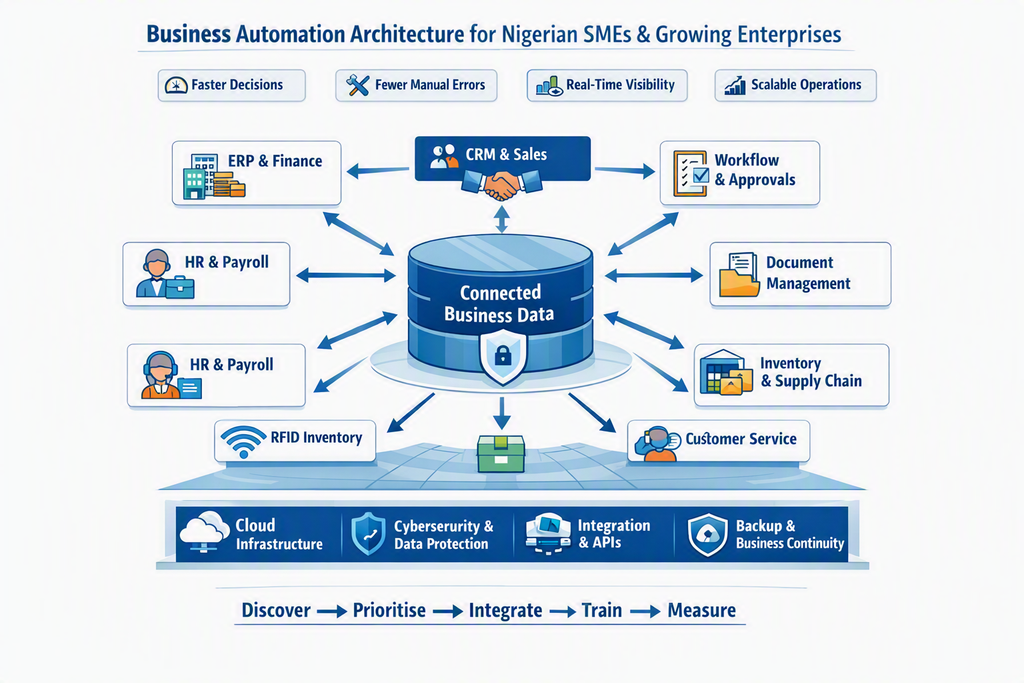
Figure 1: A connected business automation ecosystem links ERP, CRM, workflow, documents, inventory, customer service and analytics through shared data, secure infrastructure and disciplined implementation.
Business Automation Examples for Nigerian Industries
Manufacturing and distribution
A manufacturer can automate material planning, purchasing, production scheduling, quality control, stock movements, sales orders and financial reporting. Lagetronix’s ERP materials identify manufacturing, distribution, inventory, procurement and project costing as key implementation areas.
Retail and multi-location businesses
Retailers can connect inventory, purchasing, sales, customer data and branch reporting. Automated alerts can notify managers when stock falls below an agreed level or when an exception requires investigation.
Construction and project-based companies
Construction firms can automate project budgets, procurement requests, supplier records, job costing, document approvals and management reporting.
Schools and educational institutions
Lagetronix provides Educ8e for school administration and Edulynk for connecting school-management and ERP finance environments. Its educational solutions are positioned around administrative automation, financial management, communication and ERP integration.+1
Healthcare organisations
Hospitals and clinics can connect patient administration, billing, pharmacy, inventory and finance. Lagetronix’s company portfolio includes E-rapha, a hospital management solution intended to streamline operations and connect healthcare information with administrative processes.
Professional services
Consulting, legal and accounting firms can automate client onboarding, document review, time recording, invoicing, engagement approvals and recurring customer communication.
How to Implement Business Automation Successfully
1. Define the business problem
Avoid beginning with a product name. Start with the operational issue: delayed approvals, inaccurate stock, slow reporting, missed follow-ups or repeated manual entry.
2. Map the current process
Document who performs each step, what information is required, where delays occur and which systems are involved. Microsoft recommends understanding existing processes and identifying automation opportunities before scaling adoption.microsoft+1
3. Prioritise high-value processes
A good first automation project is frequent, rule-based, measurable and commercially important. Customer onboarding, purchase approvals, receivables follow-up and management reporting are often easier starting points than an organisation-wide transformation.
4. Select a right-fit platform
Compare the solution against user count, industry requirements, integrations, reporting, data hosting, security, scalability, licensing and support. Lagetronix’s ERP approach is positioned around discovery, product-fit mapping, implementation and post-deployment support rather than a one-size-fits-all product selection.+1
5. Integrate and clean the data
Automation cannot correct inaccurate source information automatically. Customer, supplier, employee, product and financial records should be reviewed before migration.
6. Build security and privacy into the design
Automated systems may process customer, employee and financial information. The Nigeria Data Protection Commission states that organisations determining how personal data is processed must ensure their collection methods comply with data-protection principles. Businesses should therefore include access control, permissions, audit trails, backups and privacy requirements in the project design.5cf5d564ad.png
7. Test, train and measure
Test real operating scenarios before full rollout. Train employees by role and measure agreed outcomes such as processing time, error frequency, reporting delay, customer response time or approval turnaround.
Why Consider Lagetronix for Business Automation?
Lagetronix is positioned as a full-service business technology solutions provider serving organisations from SMEs to large corporations. Its company portfolio covers business automation, ERP, CRM, Microsoft Azure, Microsoft 365, cybersecurity, document management, RFID inventory and industry-specific platforms.
Its automation portfolio includes:
- Sage 300 and Sage X3
- Microsoft Dynamics 365 Business Central
- Microsoft Dynamics CRM
- DocuWare document management
- Microsoft 365 and workflow solutions
- Azure cloud infrastructure
- HR and payroll systems
- RFID inventory solutions
- Educ8e and Edulynk for education
- E-rapha for healthcare
- Managed IT, cybersecurity, backup and infrastructure support
Lagetronix’s internal positioning emphasises consultative discovery, appropriate product selection, implementation, training and post-sale support. The intended outcome is to help growing Nigerian businesses replace disconnected systems with scalable platforms that provide better visibility and operational control.
Frequently Asked Questions
What are business automation solutions?
They are software and integrated technologies that execute or coordinate recurring business tasks, including approvals, invoicing, reporting, customer follow-up, payroll, stock management and document routing.
Is automation suitable for Nigerian SMEs?
Yes, but it should match the organisation’s size, budget, connectivity and digital capabilities. GIZ’s MSME study recommends incremental adoption, tailored consultancy, affordable solutions and training rather than an identical approach for every business.dtcnigeria
What business process should I automate first?
Start with a repetitive process that has clear rules and a measurable impact on revenue, cash flow, customer service or productivity.
What is the difference between ERP and workflow automation?
ERP connects major functions such as finance, inventory, procurement, sales and manufacturing. Workflow automation coordinates specific actions such as approvals, notifications and task routing. The two can work together.
Can automation integrate with existing software?
Integration may be possible through built-in connectors, APIs or customised interfaces, depending on the products involved. Microsoft Power Automate, for example, supports workflows across Microsoft products and connected services.microsoft
How much do business automation solutions cost in Nigeria?
Cost depends on the number of users, modules, integrations, data migration, customisation, deployment model, training and support. A process assessment is necessary before producing a credible budget.
Build a More Connected and Efficient Business
Business automation should give your organisation more than digital forms. It should create clearer processes, stronger accountability, connected information and better management visibility.
Whether your priority is ERP, CRM, workflow automation, document management, inventory, finance, HR, customer service or an industry-specific system, the right starting point is a structured review of your current operations.
Lagetronix can help you assess your processes, identify suitable automation opportunities and select a solution aligned with your business goals.
Request a Business Automation Consultation
- Website: lagetronix.com
- Email: sales@lagetronix.com
- Sales: 09165120977
- Support: 02018880031
- Head Office: 9, Olaiya Street, Opp. Governor’s Avenue, Alausa, Ikeja, Lagos.


