
Manufacturing Cost Control: 8 Hidden Costs ERP Helps You Find and Reduce
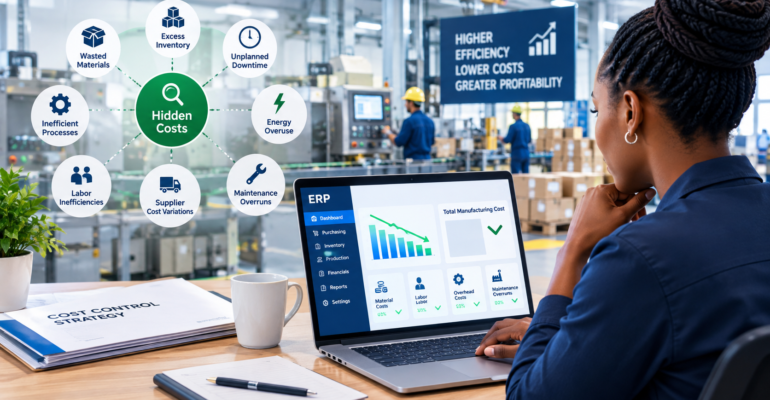
Manufacturing Cost Control: 8 Hidden Costs ERP Helps You Find and Reduce
 Lagetronix
Manufacturing Cost Control is becoming increasingly important for manufacturers trying to protect profit margins, reduce operational waste and gain better visibility into the true cost of production.
A factory can be producing more and still be making less money.
Production volume may increase. Sales may look healthy. Machines may be running and customer orders may be leaving the factory.
Yet margins continue to shrink.
Management naturally looks at raw material prices, energy costs, inflation and exchange rates. While these pressures matter, they are not always the complete picture.
Some of the most damaging manufacturing costs can originate inside the operation itself:
- Excess material consumption
- Unplanned downtime
- Excess inventory
- Poor production scheduling
- Scrap and rework
- Emergency procurement
- Uncontrolled production costs
- Inaccurate product costing
When this information is scattered across spreadsheets, accounting applications, warehouse records and production reports, identifying where margins are being lost becomes much harder.
This is where an integrated ERP strategy becomes valuable.
Manufacturers can use ERP to connect information across inventory, production, supply-chain planning and other operational processes. Microsoft’s manufacturing ERP guide describes modern manufacturing ERP as integrating areas such as inventory, supply-chain management and production planning.
Likewise, Sage X3 Production Management brings planning, production execution and quality management into one system, with capabilities for production-cost control, real-time production visibility, BOM planning and shop-floor control.
At Lagetronix, our approach goes beyond installing ERP software. We help manufacturers assess their processes, implement the appropriate ERP environment, train users, support adoption and maintain the system as operational requirements evolve.
This is where Manufacturing Cost Control becomes critical.
Modern manufacturing ERP connects areas such as inventory, production planning, supply chain management and other operational processes, providing manufacturers with greater visibility for planning and decision-making.
At Lagetronix, our approach is not simply to deploy ERP software.
We help manufacturers build connected business systems that make operational costs more visible, measurable and controllable.
Quick Answer: How Does ERP Help Control Manufacturing Costs?
ERP helps manufacturers control costs by connecting production, inventory, procurement, materials and financial information within an integrated business system.
Instead of discovering problems after month-end, management can use operational data to investigate:
- Actual versus planned material consumption
- Inventory levels
- Production requirements
- Procurement activity
- Work in progress
- Material shortages
- Production schedules
- Product and operational costs
ERP therefore does more than record expenses.
When properly implemented, it provides the information manufacturers need to understand where costs originate and where corrective action may be required.
What Is Manufacturing Cost Control?
Manufacturing Cost Control is the process of monitoring, analysing and managing the expenses involved in producing goods.
These costs typically include:
Direct Material Costs
Raw materials and components used to manufacture products.
Direct Labour Costs
Labour directly involved in manufacturing.
Manufacturing Overhead
Indirect production expenses required to operate the factory.
Inventory Costs
Costs associated with purchasing, handling, storing and maintaining inventory.
Quality Costs
Waste, defects, rework and other expenses associated with production quality.
Maintenance Costs
Expenses associated with keeping production equipment operational.
Effective cost control requires more than knowing how much money was spent.
Management needs to know why it was spent, where it was spent, and how that expense affected production and profitability.
Why Manufacturing Costs Become Difficult to Control
Imagine a manufacturer operating with five disconnected systems.
Procurement knows what materials cost.
Warehouse knows what materials are available.
Production knows what was consumed.
Finance knows what suppliers were paid.
Sales knows what customers paid for the finished products.
But who knows the complete story?
That is where disconnected processes become dangerous.
Each department can be individually correct while management still lacks a reliable end-to-end view of actual production performance.
The more complex a manufacturing operation becomes, the more important integrated information becomes.
8 Hidden Manufacturing Costs ERP Helps Expose
1. Excess Material Consumption
Every product should have an expected quantity of materials required for production.
But actual consumption can differ.
Small variances may appear insignificant until they are multiplied across thousands of production units.
For example, suppose a product should consume 10 kg of Material A.
If actual consumption repeatedly reaches 10.7 kg, that variance deserves investigation.
The question becomes:
Where did the extra 0.7 kg go?
Possible causes might need to be investigated in production, material handling, process design or master data.
How ERP Helps
Manufacturing ERP can connect bills of materials and production requirements.
Manufacturing ERP can provide greater visibility into the activities that influence production costs. For example, Sage X3 Production Management supports production planning, execution and quality management in one system. Sage specifically highlights production cost control, real-time production visibility, bill of materials planning, shop-floor control, quality management and end-to-end traceability among its manufacturing capabilities
Microsoft explains that Dynamics 365 production planning uses bill-of-material information to determine the materials required for production. It can consider on-hand inventory and existing supply when planning requirements.
This creates a stronger foundation for comparing expected requirements with manufacturing activity.
If you are still managing manufacturing operations across several disconnected applications, Lagetronix’s ERP implementation services can help establish a more integrated operational environment.
Internal link: Link ERP implementation services to the relevant Lagetronix ERP service page.
2. Excess Inventory Tying Up Working Capital
Inventory sitting in your warehouse is not free.
Capital has already been invested in it.
Yet many manufacturers continue purchasing materials without sufficient visibility into:
- Existing inventory
- Future production requirements
- Materials already ordered
- Customer demand
- Slow-moving stock
The result can be a warehouse full of inventory while the business experiences cash-flow pressure.
How ERP Helps
ERP allows inventory data to interact with manufacturing planning rather than existing as an isolated warehouse record.
Modern manufacturing ERP typically integrates inventory and materials management with production and supply-chain planning.
Better visibility allows management to ask:
- Which materials are moving?
- Which materials are sitting?
- What do upcoming production plans require?
- Where should purchasing decisions be reviewed?
For a deeper discussion, link this section internally to our Inventory Management for Manufacturing Companies article.
Internal link anchor: Inventory Management for Manufacturing Companies
3. Production Downtime
A machine stops.
Production stops.
Employees wait.
Orders fall behind.
Yet salaries, factory overheads and other business costs continue.
The visible cost is the repair.
The bigger management question is the operational impact of the interruption.
Why Downtime Matters
Downtime can affect:
- Scheduled production
- Resource availability
- Customer commitments
- Production output
- Maintenance activity
The faster management can see disruptions and understand their operational consequences, the faster the organisation can respond.
How ERP Helps
Manufacturing ERP can bring production planning and shop-floor information into the broader operational environment. Microsoft lists shop-floor control, production planning and scheduling among common manufacturing ERP capabilities.
Technology cannot prevent every equipment problem, but it can improve visibility around production activities and constraints.
4. Emergency Procurement
One of the most expensive phrases in manufacturing is:
“We need it urgently.”
Emergency purchasing often begins somewhere earlier in the process.
A material requirement was not identified early enough.
Inventory information was inaccurate.
Production demand changed.
A supplier delivery did not align with the requirement.
Whatever the reason, procurement suddenly has to act quickly.
Urgency weakens purchasing flexibility.
Manufacturers with complex production, inventory and supply-chain requirements can also explore our Sage X3 ERP solutions to understand how an integrated ERP platform can support manufacturing operations.
How ERP Helps
ERP helps connect purchasing requirements with inventory and production planning.
Microsoft’s production planning documentation explains that master planning evaluates requirements using information such as on-hand inventory and existing supply and can create planned orders when more material is required.
Planning does not eliminate supply-chain disruptions.
But it can give teams better information for identifying requirements earlier.
Companies evaluating more sophisticated manufacturing and supply-chain requirements can also assess our Sage X3 ERP solutions against their operational needs.
Internal link anchor: Sage X3 ERP solutions
5. Production Scheduling Inefficiencies
Being busy is not the same as being efficient.
A factory may appear fully occupied while poor scheduling is quietly increasing costs.
Production teams can face:
- Material availability constraints
- Changing priorities
- Resource conflicts
- Waiting time
- Delayed orders
The problem often originates from planning without a connected picture of demand, materials and resources.
How ERP Helps
Manufacturing ERP commonly includes production planning and scheduling capabilities intended to streamline operations.
For a detailed explanation of this issue, connect this section to our Production Planning for Manufacturing Companies guide.
Internal link anchor: Production Planning for Manufacturing Companies
This creates an important SEO relationship between your manufacturing articles:
Manufacturing ERP → Inventory → Production Planning → Cost Control
That is how we begin developing deeper topical authority rather than publishing isolated posts.
6. Scrap, Rework and Quality Problems
This is one of the easiest costs to underestimate.
When a defective product has to be produced again, the company may consume additional:
- Materials
- Labour
- Equipment capacity
- Production time
Repeated quality problems can therefore create operational and financial pressure well beyond the rejected product itself.
How ERP Helps
Modern manufacturing ERP can include quality and compliance tracking across stages of production.
A connected system can give quality information greater visibility within the wider production environment.
The goal is not simply to record defects.
It is to create better information for identifying where quality problems are occurring and supporting corrective decisions.
7. Poor Product Costing
Here is a dangerous business question:
Do you know exactly how much each product costs you to manufacture?
Not approximately.
Not what the spreadsheet calculated six months ago.
But the cost based on the operational information currently available.
Without reliable costing, manufacturers risk:
- Pricing products incorrectly
- Prioritising low-margin products
- Misunderstanding profitability
- Making poor sales decisions
Revenue can look impressive while margins are deteriorating underneath.
How ERP Helps
An integrated ERP environment brings operational and financial processes closer together.
Management can build a stronger view of manufacturing performance by using connected information instead of manually reconciling production and finance reports.
Lagetronix also provides Microsoft Dynamics ERP solutions for organisations evaluating integrated enterprise platforms.
Internal link anchor: Microsoft Dynamics ERP solutions
8. Decisions Made With Outdated Information
This may be the most expensive hidden cost of all.
Not material.
Not equipment.
Not labour.
Delayed decisions.
Imagine discovering at month-end that a production issue has reduced the margin on a key product.
The important question is:
Could management have responded differently if the problem had become visible earlier?
That is why improving visibility matters.
How ERP Helps
Modern manufacturing ERP can provide real-time insights across connected operations, helping organisations make decisions using more current information.
The purpose of digital transformation should therefore not be creating more dashboards.
It should be enabling better decisions.
What Should Manufacturing Management Be Measuring?
Technology alone will not create better cost control.
Management also needs meaningful performance indicators.
Depending on the organisation, these might include:
- Material consumption variance
- Production output
- Work in progress
- Inventory levels
- Production schedule performance
- Scrap and rework
- Product cost
- Inventory movement
- Supplier activity
The exact KPIs should reflect the company’s operational priorities.
Avoid implementing dozens of dashboards simply because the ERP can produce them.
Measure what helps management make decisions.
Why Spreadsheets Become a Cost-Control Risk
Excel remains an extremely useful business tool.
The problem arises when spreadsheets become the primary system holding critical operational information across a growing manufacturing business.
Consider what happens when:
Finance has one spreadsheet.
Production has another.
Warehouse has another.
Procurement has another.
Management maintains another.
Which one is correct?
Teams then spend time reconciling:
- Versions
- Quantities
- Dates
- Costs
- Adjustments
The problem is not Excel itself.
The problem is attempting to use disconnected files as an enterprise manufacturing system.
Can AI Improve Manufacturing Cost Control?
AI is increasingly being incorporated into enterprise business systems.
Microsoft describes manufacturing ERP capabilities that incorporate predictive analytics, automation, forecasting and natural-language interfaces.
More recently, Microsoft has discussed agentic ERP environments where signals across demand, supply, capacity and cost can support operational decision-making.
But manufacturers should not rush into AI expecting it to fix poor operational foundations.
AI needs reliable data.
If inventory information is unreliable, processes are fragmented and critical manufacturing information is spread across uncontrolled spreadsheets, adding AI does not automatically correct those issues.
ERP, process standardisation, data quality and governance provide a stronger foundation for advanced automation and AI.
How to Build Better Manufacturing Cost Control With ERP
Successful ERP transformation should start with the business, not the software.
Step 1: Assess Current Processes
Review:
- Production
- Inventory
- Procurement
- Warehousing
- Quality
- Maintenance
- Finance
- Reporting
Step 2: Identify Cost-Visibility Gaps
Determine where management currently struggles to obtain reliable information.
Step 3: Review Manufacturing Data
Assess:
- Products
- Materials
- Bills of materials
- Suppliers
- Customers
- Inventory data
- Financial information
Step 4: Design the Future Process
Decide how information should flow between manufacturing functions.
Step 5: Configure the ERP
Configure the selected technology around approved business requirements.
Step 6: Test Real Scenarios
ERP testing should reflect actual manufacturing transactions.
Step 7: Train Employees
Training should be role-specific and connected to everyday business processes.
Step 8: Support and Optimise
ERP should continue to evolve as manufacturing requirements change.
Microsoft likewise describes manufacturing ERP implementation as a phased approach involving planning, data migration, configuration, testing, user training and go-live support.
Why Choose Lagetronix for Manufacturing ERP?
Our ERP implementation services cover the complete transformation journey, from requirements assessment and solution design to deployment, training, support, maintenance and continuous optimisation.
Buying software is easy.
Building an ERP environment that supports the actual operation is different.
At Lagetronix, we approach ERP implementation from the business-process perspective.
We help manufacturing organisations with:
- ERP readiness assessment
- Business-process analysis
- ERP consulting
- Solution design
- ERP implementation
- Data migration
- Systems integration
- User training
- Testing
- Go-live support
- ERP maintenance
- Technical support
- Continuous optimisation
Our objective is not simply to make your ERP go live.
Our objective is to help you build a more visible, controlled and connected manufacturing operation.
You can also explore our broader business technology solutions for ERP, cloud, cybersecurity, business automation and enterprise technology requirements.
Internal link anchor: business technology solutions
Frequently Asked Questions About Manufacturing Cost Control
What is manufacturing cost control?
Manufacturing Cost Control is the process of monitoring and managing the costs involved in manufacturing goods. It helps management understand resource consumption, production costs and areas requiring corrective action.
How does ERP help with manufacturing cost control?
ERP connects manufacturing information such as inventory, material requirements, production planning and business data within an integrated environment, giving management better operational visibility.
Can ERP help reduce material waste?
ERP can provide information about planned material requirements and manufacturing activity. Microsoft Dynamics 365, for example, uses BOM information when determining production material requirements.
Can an ERP system improve production planning?
Yes. Production planning and scheduling are among the typical capabilities Microsoft identifies for manufacturing ERP systems.
Does ERP help with inventory costs?
ERP connects inventory and materials management with other manufacturing processes, improving visibility into stock and material requirements.
Can manufacturers use AI with ERP?
Modern ERP platforms increasingly include AI-enabled capabilities. Microsoft identifies predictive analytics, automation, forecasting and natural-language interfaces among AI capabilities associated with modern manufacturing ERP.
How do I choose a manufacturing ERP implementation partner?
Look beyond software licensing. Evaluate whether the partner can support process assessment, solution design, data migration, implementation, testing, training, go-live and ongoing optimisation.
You Cannot Control What You Cannot See
Rising costs will always challenge manufacturers.
Some costs cannot be controlled.
But hidden operational inefficiencies should not remain invisible.
Manufacturing Cost Control starts with visibility.
Management needs reliable information about materials, inventory, production requirements, procurement and operational performance to understand where intervention is required.
That is where ERP becomes valuable.
Not simply as accounting software.
Not simply as another IT system.
But as a connected operational platform that can help management understand how the manufacturing business is performing.
The ultimate goal is not to own ERP.
The goal is to build a more efficient and profitable manufacturing operation.
Is Your Factory Making More, but Keeping Less?
If production is increasing but margins remain under pressure, it may be time to look deeper into where costs are originating.
Lagetronix can help assess your manufacturing processes, identify visibility gaps and determine how the right ERP strategy can support stronger cost control.
Book a Manufacturing ERP Assessment with Lagetronix
- Website: lagetronix.com
- Email: sales@lagetronix.com
- Sales: 09165120977
- Support: 02018880031
- Head Office: 9, Olaiya Street, Opp. Governor’s Avenue, Alausa, Ikeja, Lagos.


