
Production Planning for Manufacturing Companies: How ERP Creates a Smarter Factory
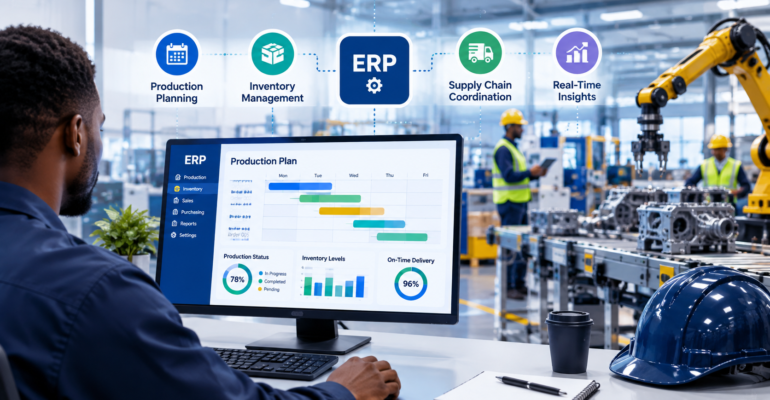
Production Planning for Manufacturing Companies: How ERP Creates a Smarter Factory
 Lagetronix
A production line can be busy all day and still be inefficient.
- Machines are running.
- Employees are working.
- Materials are moving.
- Orders are being processed.
Yet customers are still waiting, emergency purchases keep appearing, overtime is increasing and management cannot explain why actual production keeps missing the plan.
That is the difference between being busy and being productive.
For many manufacturers, the problem starts with production planning.
Production Planning for Manufacturing Companies is the process of determining what should be produced, how much should be produced, what materials and resources are required, and when production should take place.
When those decisions are based on spreadsheets, outdated inventory figures or disconnected departmental information, even a good production team is forced to operate reactively.
A properly implemented manufacturing ERP changes this. If your organization is still working across disconnected applications, our ERP implementation services can help connect finance, inventory, procurement and production in a unified environment
Microsoft describes modern manufacturing ERP as connecting functions including inventory, supply-chain planning and production, while providing real-time information for operational decision-making. [microsoft.com]
The real value, however, is not simply having another system.
It is creating a factory where sales demand, inventory availability, procurement, production capacity and financial information can work together.
Quick Answer: How Does ERP Improve Production Planning?
ERP improves production planning by connecting demand, inventory, bills of materials, purchasing and production information in a unified system.
Instead of building a production schedule without knowing whether the required materials will be available, planners can use current information to make better production decisions.
Manufacturing ERP can support capabilities such as:
- Production planning and scheduling
- Material requirements
- Bills of materials
- Routing
- Shop-floor control
- Inventory management
- Quality management
- Demand forecasting
- Supply-chain planning
Microsoft identifies these among the capabilities typically found in modern manufacturing ERP solutions.
The outcome manufacturers should pursue is simple:
Produce what is needed, when it is needed, with the right materials and resources at the right cost.
What Is Production Planning in Manufacturing?
Production planning determines how a manufacturer will convert demand into finished products.
It answers fundamental questions such as:
- What do we need to manufacture?
- How much do we need to produce?
- When should production begin?
- What raw materials will be required?
- Do we have those materials?
- What machines and work centres are required?
- What capacity is available?
- When can the finished products be delivered?
When answers to these questions exist in separate systems, production planning becomes difficult.
Sales may have received a major order that production has not fully accounted for.
Procurement may not know which materials will soon be required.
The warehouse may show quantities that do not reflect actual availability.
Production may schedule work before critical components arrive.
This is where manufacturing ERP can provide significant operational value.
Why Poor Production Planning Becomes a Profitability Problem
Poor planning does not remain inside the factory.
It eventually reaches the balance sheet.
Consider this sequence:
Poor forecast → wrong production plan → material shortage → production interruption → emergency procurement → higher cost → late customer delivery → pressure on margin.
Or the opposite:
Overestimated demand → excess production → excess finished stock → higher storage costs → working capital tied up in inventory.
Production planning therefore affects more than output.
It can influence:
- Inventory
- Procurement
- Labour
- Equipment utilisation
- Customer service
- Working capital
- Operating cost
- Profitability
That is why production planning should not operate as an isolated factory activity.
7 Production Planning Problems ERP Can Solve
1. Production Plans Built on Inaccurate Inventory Data
A production plan is only as reliable as the information behind it.
Imagine scheduling an important production run because the system indicates that 5,000 units of a particular material are available.
Production begins.
Then the warehouse discovers the actual usable quantity is significantly lower.
Now the manufacturer has a problem.
Production may stop, procurement may need to source materials urgently, and customer commitments may be affected.
How ERP Helps
A properly configured ERP environment connects material information to production planning.
Microsoft explains that Dynamics 365 master planning can use available on-hand inventory, existing supply and planned orders when evaluating material requirements.
Instead of treating stock information and production requirements as separate datasets, planning can be based on connected information.
2. Material Shortages Disrupt Production
One missing component can prevent a manufacturer from completing a product.
This is why material planning is so important.
The problem becomes more complicated where finished products contain multiple levels of components and subcomponents.
Without a structured system, planners may struggle to determine:
- Which materials are required
- What quantity is needed
- When each material is required
- What is already available
- What has already been ordered
- What must still be purchased
How ERP Helps
Manufacturing ERP can connect bills of materials with planning.
Microsoft’s Dynamics 365 production-planning documentation explains that master planning uses active BOM information to determine materials required for production and can create planned orders when additional material is needed.
That creates a much stronger connection between production requirements and material availability.
3. Production Is Disconnected From Customer Demand
What happens if the factory is producing efficiently but producing the wrong quantities?
You still have a problem.
Overproduction creates excess finished goods.
Underproduction creates stockouts and missed sales opportunities.
Manufacturers therefore need to connect production plans with real business demand.
How ERP Helps
Modern manufacturing ERP can incorporate demand forecasting and supply-chain integration to better align production with demand and supplier timelines.
That allows planning conversations to shift from:
“What should we produce this week?”
to:
“What should we produce based on demand, available supply and operational capacity?”
That is a far more valuable question.
4. Capacity Constraints Are Discovered Too Late
Having demand and materials does not automatically mean you have the capacity to produce.
Manufacturers must also consider their production resources.
If a critical work centre is already fully allocated, adding another production order can create delays across the entire production schedule.
Poor capacity visibility can contribute to:
- Production bottlenecks
- Unnecessary overtime
- Idle resources
- Schedule changes
- Delayed customer orders
How ERP Helps
Manufacturing ERP brings production and resource information into the planning environment.
The goal is to help production teams understand the resources required to execute the plan rather than treating production orders as isolated tasks.
This allows constraints to become part of the planning conversation before they become production emergencies.
5. Departments Plan Independently
One of the biggest manufacturing challenges is not necessarily a production problem.
It is a coordination problem.
Sales has its forecast.
Warehouse has its stock report.
Procurement has its supplier information.
Production has its schedule.
Finance has its cost figures.
What happens when those numbers disagree?
Meetings.
Emails.
Phone calls.
More spreadsheets.
More reconciliation.
And slower decisions.
How ERP Helps
Modern ERP brings different areas of the manufacturing cycle together, including inventory, supply-chain planning and production.
The objective is to create a shared operational picture rather than multiple departmental versions of reality.
6. Management Cannot See Production Problems Early Enough
Here’s one question every manufacturing executive should ask:
“When production falls behind schedule, how quickly do we know?”
Immediately?
At the end of the shift?
The next morning?
At the weekly production meeting?
At month-end?
The longer it takes for operational problems to become visible, the less time management has to respond.
How ERP Helps
Manufacturing ERP can support real-time insights, shop-floor control and monitoring of production-related resources and work in progress. [microsoft.com]
The objective is not to give executives more reports.
It is to give the right people useful information early enough to act.
7. Production Costs Are Discovered After the Damage Is Done
A production order can be completed successfully and still be unprofitable.
Perhaps it consumed more materials than planned.
Maybe labour hours were higher.
Perhaps excessive scrap occurred.
Or production took longer than expected.
Management needs to understand the difference between what production should have cost and what it actually cost.
How ERP Helps
By connecting production activity with operational and financial information, ERP can support better cost visibility and analysis.
The important question is no longer merely:
“Did we produce it?”
It becomes:
“Did we produce it efficiently and profitably?”
That shift is essential for manufacturers that want sustainable growth.
What Does Effective Production Planning Look Like?
A well-planned manufacturing environment should connect several areas of the business.
Demand
What does the business expect customers to require?
Inventory
What materials and finished goods are already available?
Mater
What components will be needed to meet the production plan?
Procurement
What additional materials need to be sourced?
Production Capacity
Which resources are available to perform the work?
Scheduling
When should individual production orders run?
Execution
What is actually happening on the shop floor?
Financial Performance
How do actual production costs compare with expectations?
No single spreadsheet should be expected to manage all these relationships as manufacturing complexity increases.
Beyond Production Planning: ERP Creates Manufacturing Visibility
This is where the discussion becomes bigger than scheduling.
An ERP implementation should not simply digitise the company’s existing production spreadsheet.
It should create a connected operational environment.
For example:
A change in demand should inform planning.
Planning should influence material requirements.
Material requirements should inform procurement.
Procurement should affect material availability.
Material availability should influence production.
Production activity should update inventory.
And those activities should ultimately provide useful information to finance and management.
That is the real value of integrated manufacturing technology.
Can AI Improve Manufacturing Planning?
AI is becoming increasingly relevant within modern ERP environments.
Microsoft describes AI capabilities in manufacturing ERP as including predictive analytics, automation, forecasting tools and natural-language interfaces.
Microsoft has also described a direction toward agentic ERP where demand, supply, capacity and cost signals can support operational decisions across manufacturing.
However, manufacturers should remember something important:
AI cannot compensate for fragmented processes and unreliable underlying data.
The foundation still matters.
Before pursuing advanced AI capabilities, organizations should establish reliable data, connected workflows and appropriately configured business systems.
The Biggest Production Planning Mistake Manufacturers Make
One of the biggest mistakes is buying ERP software before properly understanding the business problem.
Software should not be the starting point.
The starting point should be questions such as:
- Where are our planning bottlenecks?
- Which production decisions rely on unreliable data?
- Where are material shortages originating?
- How are bills of materials maintained?
- How do we calculate capacity?
- How does production communicate with procurement?
- How do we measure actual versus planned performance?
- Which reports does management need?
- What information do shop-floor users require?
Only then should technology be configured around the required future-state process.
How Should Manufacturing ERP Be Implemented?
A strong implementation should not begin with software configuration.
1. Assess Existing Manufacturing Processes
Understand production, inventory, procurement, quality, warehousing, finance and reporting.
2. Identify Operational Gaps
Determine where delays, manual processes, duplicated work and visibility problems exist.
3. Design the Future Process
Define how the organization wants planning and execution to operate after implementation.
4. Configure the ERP
Configure the selected system around the approved requirements.
5. Prepare and Migrate Data
Product, inventory, supplier, customer and manufacturing master data should be reviewed before migration.
6. Test Real Manufacturing Scenarios
Testing should reflect how the factory actually operates.
7. Train Users
Planners, production teams, warehouse users, procurement, finance and management need role-relevant training.
8. Go Live and Optimise
Implementation should be followed by support, adoption monitoring and continuous improvement.
Microsoft similarly describes manufacturing ERP implementation as generally involving planning, data migration, configuration, testing, user training and go-live support.
How to Choose a Manufacturing ERP Implementation Partner
This is just as important as choosing the software.
Don’t ask only:
“Can you implement ERP?”
Ask:
- Do you understand manufacturing?
- Can you map our production processes?
- Can you help us improve inefficient workflows?
- How will you handle our manufacturing data?
- How will you test our production scenarios?
- How will you train users?
- What happens after go-live?
- Who supports us when our requirements change?
Manufacturing ERP implementation should not end when the software starts working.
The goal should be to create a solution that continues supporting the business as operations evolve.
Why Choose Lagetronix for Manufacturing ERP Implementation?
At Lagetronix, our approach is not simply to install software.
We help manufacturers understand where technology can improve operations before determining how the ERP should be implemented.
Our manufacturing ERP services cover:
- ERP and business-process assessment
- ERP consulting
- Solution design
- ERP implementation and deployment
- Manufacturing process configuration
- Data migration
- Business-system integration
- User training
- Testing and go-live support
- ERP maintenance
- Post-implementation support
- Continuous optimisation
This approach matters because your ERP should fit the realities of your operation, not force your entire manufacturing business into a generic template.
Our objective is straightforward:
Help manufacturers see what is happening, understand why it is happening and have the systems required to act.
Frequently Asked Questions About Production Planning for Manufacturing Companies
What is production planning for manufacturing companies?
Production Planning for Manufacturing Companies involves determining what to manufacture, how much to produce, when production should occur and what materials and resources will be required.
How does ERP help with production planning?
ERP can connect production planning with inventory, bills of materials, supply information and manufacturing requirements, allowing planning decisions to use connected operational data.
What is the role of a BOM in production planning?
A bill of materials identifies the components required for a product. Microsoft Dynamics 365 master planning can use BOM information to determine material requirements for planned production.
Can ERP help prevent material shortages?
ERP planning can consider on-hand inventory and supply when calculating requirements. In Microsoft Dynamics 365, master planning can generate planned orders when additional material is required.
Can ERP improve manufacturing efficiency?
Manufacturing ERP is designed to integrate areas such as inventory, planning and production, and Microsoft identifies productivity, resource management and cost efficiency among its manufacturing ERP benefits.
When should a manufacturing company consider ERP?
A manufacturer should investigate ERP when disconnected systems, unreliable inventory data, planning difficulties, manual reporting or increasing operational complexity are preventing teams from making timely decisions.
What should I look for in a manufacturing ERP partner?
Look for a partner who understands manufacturing processes and can support assessment, solution design, configuration, data migration, testing, training, deployment and continuing support.
Conclusion
A factory doesn’t become more efficient simply because its machines are running.
Efficiency comes from coordinating demand, materials, people, equipment, processes and information.
That is why Production Planning for Manufacturing Companies must move beyond spreadsheets and isolated departmental decisions as businesses become more complex.
Manufacturing ERP provides the foundation for connecting production with inventory, materials, supply-chain planning and other critical business information.
But ERP success ultimately depends on how well the solution is designed, implemented, adopted and supported.
The goal should not simply be to implement ERP.
The goal should be to build a better manufacturing operation.
Is Your Production Plan Connected to the Rest of Your Business?
If production regularly faces material shortages, changing schedules, delayed information or limited visibility, the problem may be deeper than production itself.
Lagetronix can help you assess your manufacturing processes and determine where ERP can create stronger control, visibility and operational efficiency.
Book a Manufacturing ERP Assessment
Let’s identify the gaps before they become tomorrow’s production problems.


