
ERP Implementation Cost in Nigeria: 2026 Guide
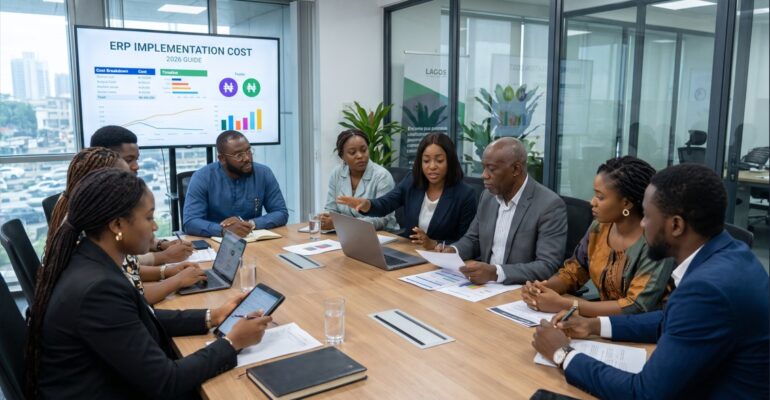
ERP Implementation Cost in Nigeria: 2026 Guide
 Lagetronix
ERP Implementation Cost in Nigeria depends on far more than the price of the software licence. A realistic ERP budget must also include business-process assessment, configuration, data migration, integrations, testing, training, project management, go-live support and ongoing maintenance.
This is why two Nigerian companies can select the same ERP platform and receive completely different quotations.
One organisation may need only finance, sales and inventory modules for 15 users.
Another may require manufacturing, procurement, warehouse management, project accounting, multiple companies, several locations, historical data migration, customised reports and integration with existing applications.
The software platform may be the same.
The implementation scope is not.
The most important question is therefore not:
“How much does ERP software cost?”
The better question is:
“What will it cost to make the ERP work correctly for our business?”
This guide explains the major ERP cost components, indicative Nigerian market ranges, common hidden expenses and how to build a realistic implementation budget.
Quick Answer: How Much Does ERP Implementation Cost in Nigeria?
There is no single price for ERP implementation in Nigeria.
Published Nigerian market guides suggest that implementation can range from under ₦1 million for limited small-business deployments to more than ₦100 million for complex enterprise projects.
These are broad third-party market estimates, not Lagetronix quotations.
The final price depends on:
- ERP platform
- Number of users
- Required modules
- Number of companies and locations
- Business-process complexity
- Data migration
- Customisation
- Integrations
- Reporting requirements
- Training and change management
- Cloud or on-premises infrastructure
- Post-implementation support
A proper quotation should therefore follow a requirements assessment rather than a short software demonstration.
What Is Included in ERP Implementation Cost?
ERP Implementation Cost in Nigeria is the total expenditure required to make an ERP system operational for a particular organisation.
It can include:
- Software licences or subscriptions
- ERP consulting
- Business-process assessment
- Requirements gathering
- Solution design
- System configuration
- Customisation
- Data preparation and migration
- Third-party integrations
- Report and dashboard development
- User-acceptance testing
- Employee training
- Project management
- Go-live support
- Post-implementation support
- Infrastructure
- Future upgrades and optimisation
The licence gives your organisation access to the software.
Implementation turns that software into a working business system.
For example, purchasing ERP licences does not automatically configure:
- Your chart of accounts
- Warehouses and locations
- Approval hierarchies
- Bills of materials
- Production processes
- Project-costing rules
- Financial dimensions
- Procurement workflows
- Tax configurations
- Management reports
- User permissions
- Existing system integrations
That work forms part of the implementation.
Why ERP Prices Vary So Widely
ERP quotations vary because businesses vary.
A construction company managing project costs, subcontractors, equipment, procurement and multiple sites has different requirements from a professional-services company managing finance, customers and employee time.
A manufacturer managing raw materials, production orders, bills of materials, work in progress, quality control and finished goods will generally need a more complex solution than a small trading business.
Businesses should therefore be cautious about comparing ERP quotations only by total price.
A lower quotation may exclude important activities such as:
- Data migration
- Process mapping
- Departmental training
- Custom reporting
- Integration
- User-acceptance testing
- Post-go-live support
Before comparing two quotations, confirm that both vendors are pricing the same scope.
10 Factors That Affect ERP Implementation Cost in Nigeria
1. The ERP Platform
The selected ERP platform has a major impact on cost.
Nigerian businesses may evaluate platforms such as:
- Microsoft Dynamics 365 Business Central
- Microsoft Dynamics 365 Finance
- Microsoft Dynamics 365 Supply Chain Management
- Sage 300
- Sage X3
- SAP Business One
- Oracle NetSuite
- Odoo
- ERPNext
- Custom ERP systems
These platforms serve different organisational sizes, industries and levels of complexity.
An open-source platform may have lower licensing costs but still require significant expenditure on implementation, localisation, hosting, development, support and upgrades.
An established commercial ERP may carry higher licensing costs but offer broader standard capabilities, vendor support and a more structured product roadmap.
The decision should not be based on licence price alone.
It should consider:
- Required functionality
- Scalability
- Support availability
- Reporting
- Integration
- Security
- Industry suitability
- Total cost of ownership
Lagetronix’s ERP portfolio covers Microsoft Dynamics and Sage solutions, with high-intent internal positioning around ERP implementation, business automation and consulting in Nigeria.
2. The Number and Type of Users
Cloud ERP platforms commonly use subscription-based licensing.
However, not every employee necessarily needs the same licence type.
Your organisation may have:
- Full users
- Finance users
- Operations users
- Team members
- Warehouse users
- Production users
- Approvers
- Read-only users
- External users
A proper licensing assessment should map each employee’s responsibilities to the appropriate user type.
Over-licensing increases recurring costs.
Under-licensing may prevent employees from performing required activities or create compliance concerns around shared accounts.
The objective is not to buy as few licences as possible.
It is to assign the right licence to each legitimate user role.
3. The Number of ERP Modules
A finance-only implementation is different from an enterprise-wide transformation.
Common modules include:
- General ledger
- Accounts receivable
- Accounts payable
- Cash management
- Fixed assets
- Sales
- Procurement
- Inventory
- Warehouse management
- Manufacturing
- Project management
- Human resources
- Payroll
- Customer relationship management
- Service management
- Budgeting
- Business intelligence
Each additional module introduces more requirements, configuration, testing and training.
A phased approach can help control risk.
For example:
Phase One
- Finance
- Sales
- Procurement
- Inventory
Phase Two
- Manufacturing
- Warehouse management
- Projects
- Service management
Phase Three
- Advanced reporting
- Automation
- AI capabilities
- Additional integrations
Phasing can reduce initial complexity, but the complete roadmap should be considered during the original design.
4. Business-Process Complexity
Company size alone does not determine ERP cost.
A 50-person manufacturing company may have more implementation complexity than a 200-person professional-services organisation.
Complexity can come from:
- Multiple approval levels
- Intercompany transactions
- Multiple currencies
- Several warehouses
- Manufacturing formulas
- Complex bills of materials
- Batch or serial tracking
- Project costing
- Quality control
- Contract billing
- Regulatory requirements
- Group consolidation
- Multiple legal entities
This is why ERP pricing should follow process discovery.
The implementation partner needs to understand how the business operates before providing a dependable scope.
5. Data Migration
Data migration is frequently underestimated.
Businesses may need to migrate:
- Customers
- Suppliers
- Products
- Inventory balances
- Chart of accounts
- Opening balances
- Fixed assets
- Open sales orders
- Open purchase orders
- Outstanding receivables
- Outstanding payables
- Historical transactions
- Bills of materials
- Production data
- Project information
The cost depends on:
- Data volume
- Number of legacy systems
- Data quality
- Required history
- Duplicate records
- Missing information
- Transformation requirements
- Validation effort
One published Nigerian guide estimates that data migration and training can add materially to the implementation budget, although the exact percentage will vary by project.
Poor data should not be moved simply because it exists.
Before migration, businesses should:
- Define what data is genuinely required.
- Remove duplicates.
- Correct inaccurate records.
- Assign data owners.
- Validate opening balances.
- Test migration more than once.
- Obtain departmental sign-off.
The principle remains simple:
A new ERP cannot produce reliable information from unreliable data.
6. Customisation
Customisation can increase implementation and long-term maintenance costs significantly.
Businesses often request customisation because they want the new ERP to copy their old system exactly.
That approach can recreate outdated processes inside a modern platform.
Before approving a customisation, ask:
- Is the requirement legally necessary?
- Does it create a genuine competitive advantage?
- Can a standard ERP function meet the requirement?
- Can the process be redesigned?
- Can configuration solve it?
- Can an integration address it?
- How will the customisation affect upgrades?
- Who will maintain it?
Customisation should be controlled through a documented fit-gap assessment.
Use standard functionality where it supports the business requirement adequately.
Customise where there is a defensible operational reason.
7. Integration With Other Systems
Modern ERP rarely operates alone.
It may need to connect with:
- Banks
- Payment gateways
- CRM
- E-commerce platforms
- Payroll
- Manufacturing systems
- Warehouse applications
- Microsoft 365
- Power BI
- Document management
- Industry-specific software
- E-invoicing platforms
- Tax systems
- Custom applications
Each integration requires:
- Data mapping
- Security design
- Development or configuration
- Testing
- Error handling
- Monitoring
- Documentation
- Ongoing support
Businesses should clarify whether integration costs are included in the original quotation or priced separately.
An interface that works during a demonstration is not necessarily production-ready.
Production integration needs to manage failures, duplicate transactions, incomplete information, authentication changes and service interruptions.
8. Reporting and Dashboards
Standard ERP reports may not answer every management question.
Organisations may require:
- Executive dashboards
- Profitability reports
- Product-margin reports
- Project-costing reports
- Inventory analysis
- Cash-flow reports
- Budget-versus-actual reporting
- Manufacturing-performance dashboards
- Group consolidation
- Regulatory reports
Each custom report requires requirements gathering, data mapping, development, testing and user acceptance.
Before requesting dozens of reports, identify:
- Who will use each report?
- Which decision will it support?
- How frequently is it required?
- Is the information already available in another report?
- Does the underlying data exist reliably?
More reports do not automatically create better decisions.
9. Training and Change Management
ERP implementation changes how people work.
Employees may need to adopt:
- New approval processes
- New user roles
- New reporting responsibilities
- Different data-entry standards
- Stronger accountability
- More structured workflows
Training should therefore be role-based.
Finance users need different training from warehouse employees, production teams, salespeople and executives.
A strong plan may include:
- Project-team training
- Departmental training
- End-user sessions
- Train-the-trainer programmes
- User guides
- Practical exercises
- Refresher sessions
- Post-go-live support
Training should not be reduced to a few generic demonstrations immediately before go-live.
Poor adoption can make an effective ERP look like a failed system.
10. Support, Maintenance and Optimisation
Go-live is not the end of ERP expenditure.
Businesses should budget for the complete lifecycle.
Ongoing costs may include:
- Licence renewals
- Cloud subscriptions
- Support
- Maintenance
- Security updates
- Data storage
- User onboarding
- Additional reports
- New workflows
- Integration updates
- Version upgrades
- Performance optimisation
- Further training
Your ERP budget should distinguish between:
One-Time Costs
- Assessment
- Implementation
- Data migration
- Initial integration
- Initial training
- Deployment
Recurring Costs
- Licences
- Hosting
- Support
- Maintenance
- Monitoring
- Upgrades
- Additional optimisation
A lower implementation quotation may become more expensive over time if support and maintenance were not considered properly.
Indicative ERP Cost Ranges in Nigeria
Available public Nigerian guides show extremely wide market ranges.
One 2026 guide places the broad market between approximately ₦800,000 and more than ₦100 million, depending on whether the project is a limited open-source deployment, mid-market solution or complex enterprise system.
Another Nigerian guide presents an indicative range of approximately ₦500,000 to ₦40 million when comparing custom and off-the-shelf systems.
These figures should be treated carefully.
They are third-party market estimates, not standard prices and not Lagetronix quotations.
A credible ERP partner should not price a serious implementation solely from:
- Number of employees
- Company turnover
- A short phone call
- A product name
- A one-page feature list
The project should first establish the requirements.
Hidden ERP Costs Nigerian Businesses Often Miss
Internal Employee Time
Your own employees will participate in workshops, data preparation, testing and training.
That internal time has a cost.
Process Redesign
Some existing processes may need to change before they can be implemented effectively.
Data Cleansing
Employees may need to correct years of inconsistent customer, supplier, stock and financial records.
Infrastructure
On-premises deployments may require servers, storage, backup, networking, power and disaster-recovery arrangements.
Additional Environments
Larger projects may need development, testing, user-acceptance and production environments.
Post-Go-Live Support
The first weeks after launch often require concentrated support.
Exchange-Rate Exposure
Where licences or subscriptions are priced in foreign currency, Nigerian businesses should consider exchange-rate exposure in their budgets.
Scope Changes
New requirements discovered after approval can create change requests and additional costs.
Business Disruption
Employees need time to learn the system and adapt to new processes.
Cloud ERP vs On-Premises ERP Cost
Cloud ERP
Cloud ERP generally uses recurring subscriptions.
Potential advantages include:
- Lower infrastructure responsibility
- Faster provisioning
- Easier remote access
- Vendor-managed platform updates
- More predictable subscription structure
Potential considerations include:
- Recurring licence costs
- Internet dependency
- Foreign-currency exposure
- Data and integration requirements
- Long-term subscription cost
On-Premises ERP
On-premises ERP may involve a higher initial infrastructure investment.
Costs can include:
- Servers
- Storage
- Networking
- Database licences
- Backup
- Security
- Power
- Cooling
- Internal administration
- Disaster recovery
The better option depends on workload, security, operational and financial requirements.
Do not assume cloud is automatically cheaper or on-premises is automatically more secure.
Evaluate total cost of ownership over at least three to five years.
How to Build a Realistic ERP Budget
Understanding ERP Implementation Cost in Nigeria requires businesses to look beyond software licensing and evaluate the complete project lifecycle, including consulting, configuration, data migration, integrations, training, testing, support and ongoing optimisation.
Step 1: Define the Business Case
Document the primary problems the ERP should solve.
Examples include:
- Slow financial reporting
- Inaccurate inventory
- Disconnected departments
- Weak project-cost control
- Manual procurement
- Limited production visibility
Step 2: Define the Scope
Identify modules, companies, locations, users, reports and integrations.
Step 3: Map Existing Processes
Understand how the business currently operates.
Step 4: Conduct a Fit-Gap Assessment
Compare requirements against standard ERP capabilities.
Step 5: Assess Data
Determine what information must be cleansed and migrated.
Step 6: Calculate Total Cost of Ownership
Include one-time and recurring expenditure.
Shopify recommends evaluating ERP total cost of ownership across software, implementation, internal resources, migration, integrations and contingency. [shopify.com]
Step 7: Include Contingency
ERP projects can reveal previously undocumented requirements.
A controlled contingency budget is generally more responsible than assuming no changes will occur.
Step 8: Link Cost to Expected Business Value
Define the expected improvement in:
- Reporting time
- Inventory control
- Process efficiency
- Operational visibility
- Cost control
- Customer service
- Compliance
- Scalability
The Cheapest ERP Quote May Be the Most Expensive
A low quotation can be attractive.
But before approving it, examine what is excluded.
Ask whether the proposal covers:
- Process assessment
- Data migration
- Integrations
- Custom reports
- Testing
- Training
- Go-live support
- Post-implementation support
- Project management
- Documentation
An inexpensive deployment that fails to support the business can create:
- Reimplementation costs
- Data corrections
- Additional consulting
- Employee frustration
- Operational disruption
- Lost management confidence
Price matters.
Scope clarity matters more.
Questions to Ask Before Accepting an ERP Quotation
- Which modules are included?
- How many users and licence types are covered?
- Is business-process discovery included?
- What data will be migrated?
- How many migration test cycles are included?
- Which integrations are included?
- Are custom reports included?
- Who is responsible for data cleansing?
- What training will each department receive?
- Is user-acceptance testing included?
- What happens during go-live?
- How long is post-go-live support?
- What costs recur annually?
- What assumptions could affect the price?
- How will change requests be handled?
The proposal should make these details clear.
Why Choose Lagetronix for ERP Implementation in Nigeria?
At Lagetronix, we help organisations understand ERP Implementation Cost in Nigeria by first defining the business requirements, implementation scope, users, modules, data requirements, integrations and support expectations before preparing the final project roadmap.
The right ERP partner should help your organisation understand the project before asking it to commit to the software.
At Lagetronix, our approach begins with business requirements.
Our documented ERP services include:
- ERP readiness assessment
- Business-process analysis
- Microsoft Dynamics solutions
- Sage ERP implementation
- Business automation
- Data migration
- Systems integration
- User training
- Testing and go-live support
- Post-implementation support
- Continuous optimisation
Lagetronix’s internal SEO and service strategy positions the company around ERP implementation, Microsoft Dynamics, Sage solutions and business automation for Nigerian organisations.
The objective is not simply to give the customer a software price.
It is to build a clear implementation scope that explains:
- What will be delivered
- What the customer must provide
- What the project will cost
- Which assumptions apply
- What happens after go-live
That transparency helps reduce unrealistic expectations and avoid budget surprises.
Frequently Asked Questions
How much is ERP Implementation Cost in Nigeria?
ERP Implementation Cost in Nigeria can range from relatively small deployments to enterprise projects costing tens of millions of naira. The correct price depends on platform, users, modules, complexity, migration, integrations, training and support.
Is the ERP licence included in implementation cost?
Sometimes, but not always. Businesses should confirm whether software subscriptions or licences are included or quoted separately.
Why is ERP implementation more expensive than the software?
The software provides the platform. Implementation includes the professional work required to configure, integrate, migrate, test, train and deploy it for the organisation.
Which ERP is best for Nigerian businesses?
The best ERP depends on company size, industry, processes, users, integration requirements and growth plans. Options may include Microsoft Dynamics, Sage, SAP, Oracle NetSuite, Odoo and ERPNext.
Should a business choose cloud or on-premises ERP?
The decision should consider infrastructure, security, connectivity, recurring expenditure, internal expertise and long-term total cost of ownership.
How long does ERP implementation take?
A limited deployment may take a few months. More complex, multi-module or multi-company implementations can take significantly longer. The timeline should follow confirmed scope and organisational readiness.
Can ERP be implemented in phases?
Yes. A phased approach can reduce implementation risk and spread investment, provided the overall architecture and roadmap are defined properly.
Does Lagetronix implement Microsoft Dynamics and Sage ERP?
Yes. Lagetronix’s ERP portfolio includes Microsoft Dynamics and Sage ERP solutions, supported by consulting, implementation, integration, training and support capabilities. [Lagetronix…r Document | Word]
Conclusion: Budget for the Business Outcome, Not Only the Software
The most important lesson about ERP Implementation Cost in Nigeria is that the software price is only one part of the investment.
A realistic budget should cover:
Assessment.
Process design.
Licences.
Configuration.
Data migration.
Integration.
Testing.
Training.
Go-live.
Support.
Optimisation.
Cutting every possible cost may produce a cheaper quotation.
It does not necessarily produce a successful ERP.
The better objective is to build a scope that is financially realistic, operationally appropriate and aligned with measurable business outcomes.
How Much Should Your ERP Project Cost?
The only responsible way to answer that question is to understand your requirements.
Book an ERP Cost and Readiness Assessment with Lagetronix.
Our team will help you evaluate:
- Required ERP modules
- Users and licence options
- Business processes
- Data migration
- Integration requirements
- Reporting
- Training
- Implementation timeline
- Support
- Total cost of ownership
Contact us todday to get a clearer ERP roadmap before committing your budget.
Lagetronix | ERP engineered around business outcomes.
- Email: sales@lagetronix.com
- Sales: 09165120977
- Support: 02018880031
- Head Office: 9, Olaiya Street, Opp. Governor’s Avenue, Alausa, Ikeja, Lagos.


