
Inventory Management for Manufacturing Companies: 10 Costly Mistakes That Reduce Profitability
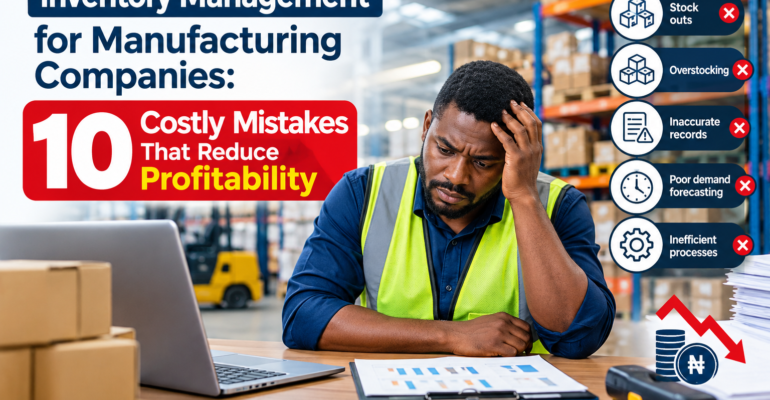
Inventory Management for Manufacturing Companies: 10 Costly Mistakes That Reduce Profitability
 Lagetronix
Quick Answer
Inventory management for manufacturing companies involves controlling raw materials, work-in-progress inventory, finished goods, and warehouse operations. Poor inventory management leads to stockouts, excess inventory, production delays, inaccurate forecasting, and reduced profitability. A modern ERP system solves these challenges by providing real-time inventory visibility, automated replenishment, production planning integration, and detailed reporting that supports better decision-making.
Why Inventory Management Is One of the Biggest Challenges in Manufacturing
For many manufacturing companies, inventory is both their largest asset and their largest hidden liability.
Too much inventory locks up cash.
Too little inventory disrupts production.
Inaccurate inventory data leads to procurement mistakes.
Poor inventory visibility impacts customer satisfaction.
The reality is simple:
Most manufacturers don’t lose money because they lack demand.
They lose money because they don’t have complete control over inventory.
As businesses grow, spreadsheets and disconnected inventory systems become increasingly unreliable.
Warehouse teams maintain one version of inventory records.
Procurement works with another.
Production relies on assumptions.
Finance reports different numbers.
The result is operational inefficiency that directly impacts profitability.
This is why leading manufacturers invest in ERP solutions that provide a single source of truth for inventory management.
What Is Inventory Management for Manufacturing Companies?
Inventory management for manufacturing companies refers to the process of tracking, controlling, optimizing, and managing inventory throughout the manufacturing lifecycle.
This includes:
- Raw materials
- Packaging materials
- Work in progress (WIP)
- Finished goods
- Spare parts
- Consumables
- Warehouse stock
- Goods in transit
The objective is to ensure the right inventory is available at the right time without carrying excessive stock that ties up working capital.
Effective inventory management directly affects:
- Cash flow
- Production efficiency
- Customer satisfaction
- Procurement costs
- Profitability
- Supply chain performance
Why Poor Inventory Management Is Costing Manufacturers Millions
Inventory problems rarely appear as a single issue.
Instead, they create a chain reaction throughout the organization.
For example:
- A stockout delays production.
- Production delays customer deliveries.
- Customer deliveries impact revenue.
- Revenue delays cash flow.
- Cash flow affects procurement.
- Procurement affects future production.
A single inventory problem can ripple through the entire business.
10 Inventory Management Mistakes Manufacturing Companies Make
1. Relying on Spreadsheets to Manage Inventory
Many manufacturers continue to manage inventory using Excel spreadsheets.
While spreadsheets may work initially, they become increasingly difficult to maintain as inventory volumes grow.
Common issues include:
- Duplicate records
- Manual entry errors
- Delayed updates
- Data inconsistencies
- Lack of real-time visibility
How ERP Solves This
ERP provides a centralized inventory database where all departments access the same information in real time.
2. Not Knowing Actual Inventory Levels
One of the most common challenges in manufacturing is inventory inaccuracy.
Many businesses believe they have materials available only to discover shortages during production.
This leads to:
- Production interruptions
- Emergency purchases
- Increased costs
- Delayed deliveries
How ERP Solves This
ERP tracks inventory transactions automatically and updates inventory balances in real time.
This ensures inventory records remain accurate.
3. Carrying Excess Inventory
Many manufacturers overcompensate for uncertainty by purchasing too much inventory.
While this reduces stockout risks, it creates other problems.
Excess Inventory Impacts
- Cash flow restrictions
- Increased storage costs
- Material deterioration
- Obsolete stock
- Reduced profitability
How ERP Solves This
ERP provides inventory forecasting and demand planning tools that help maintain optimal stock levels.
4. Frequent Stockouts During Production
Nothing disrupts production faster than running out of critical materials.
Stockouts force companies to:
- Pause production
- Pay premium procurement costs
- Miss delivery commitments
- Lose customer confidence
How ERP Solves This
ERP can automatically monitor stock levels and generate replenishment recommendations before materials run out.
5. Poor Demand Forecasting
Manufacturers often struggle to accurately predict future demand.
Poor forecasting creates:
- Excess inventory
- Material shortages
- Production inefficiencies
- Inaccurate purchasing decisions
How ERP Solves This
ERP combines sales history, inventory trends, and demand signals to support more accurate forecasting.
6. Lack of Inventory Traceability
Manufacturers need visibility into where materials come from and where they are used.
Without inventory traceability:
- Product recalls become difficult
- Quality investigations take longer
- Compliance risks increase
How ERP Solves This
ERP supports batch tracking, serial tracking, lot control, and complete inventory traceability.
7. Poor Warehouse Management
Many warehouses suffer from:
- Disorganized storage
- Misplaced materials
- Slow picking processes
- Inventory discrepancies
These inefficiencies increase operational costs.
How ERP Solves This
ERP improves warehouse operations through:
- Location management
- Barcode integration
- Automated stock movements
- Cycle counting
- Warehouse performance reporting
8. Procurement Decisions Based on Guesswork
When procurement lacks visibility into actual inventory requirements, purchasing decisions become reactive.
This often results in:
- Duplicate purchases
- Overstocking
- Supplier-related delays
How ERP Solves This
ERP connects procurement directly to inventory levels and production planning requirements.
Purchasing becomes proactive rather than reactive.
9. Failure to Monitor Slow-Moving Inventory
Many manufacturers unknowingly carry inventory that has not moved for months or years.
This inventory consumes warehouse space and working capital.
How ERP Solves This
ERP identifies:
- Slow-moving inventory
- Obsolete stock
- Excess inventory holdings
This supports better inventory optimization decisions.
10. Lack of Executive Visibility
Manufacturing executives need immediate insight into inventory performance.
Questions such as:
- What inventory is tying up cash?
- Which materials are at risk?
- What products are moving slowly?
- Which warehouses have excess stock?
Should not require manual investigations.
How ERP Solves This
ERP provides executive dashboards and real-time reporting that support strategic decision-making.
The Business Benefits of Manufacturing ERP for Inventory Management
When properly implemented, ERP delivers significant inventory improvements.
Improved Inventory Accuracy
Real-time inventory tracking eliminates manual discrepancies.
Better Cash Flow Management
Less cash is tied up in unnecessary inventory.
Reduced Stockouts
Materials remain available when production requires them.
Faster Procurement Decisions
Purchasing teams operate with accurate inventory data.
Increased Production Efficiency
Production schedules become more reliable.
Better Customer Satisfaction
Improved inventory management supports on-time delivery.
Improved Profitability
Reduced waste and optimized inventory contribute directly to margins.
Common Mistakes Manufacturers Make When Implementing ERP
Many manufacturers assume ERP software alone will solve inventory problems.
Unfortunately, ERP implementation can fail when:
- Business processes are not analyzed
- Inventory data is inaccurate
- Warehouse workflows are ignored
- Employees are not trained
- Post-go-live support is lacking
Successful ERP implementation requires more than technology.
It requires expertise.
How to Choose the Right ERP Implementation Partner
When evaluating ERP vendors, manufacturers should ask:
- Do they understand manufacturing operations?
- Have they implemented ERP for manufacturing companies?
- Can they support inventory optimization?
- Do they provide training?
- Do they offer long-term support?
- Can they integrate ERP with existing business systems?
- Do they understand warehouse management and production planning?
The answers often determine whether an ERP project succeeds or fails.
Why Manufacturers Choose Lagetronix
At Lagetronix Nigeria Limited, we help manufacturers gain complete control over inventory, production, procurement, warehousing, and financial operations.
Our manufacturing ERP services include:
- ERP Consulting and Advisory
- Manufacturing Process Assessment
- ERP Implementation and Deployment
- Inventory Management Optimization
- Data Migration
- Systems Integration
- User Training
- ERP Support and Maintenance
- ERP Performance Optimization
We help manufacturers move beyond spreadsheets and disconnected systems to create a modern, integrated operation capable of supporting long-term growth.
Our goal is simple:
Help manufacturers reduce waste, improve inventory visibility, increase operational efficiency, and improve profitability.
Frequently Asked Questions
What is inventory management in manufacturing?
Inventory management in manufacturing involves planning, tracking, controlling, and optimizing raw materials, work-in-progress inventory, finished goods, and warehouse operations to support efficient production and profitability.
Why is inventory management important in manufacturing?
Effective inventory management improves cash flow, reduces stockouts, minimizes waste, supports production efficiency, and improves customer satisfaction.
How does ERP improve inventory management?
ERP provides real-time inventory visibility, automated replenishment, forecasting, reporting, batch tracking, warehouse management, and integration with procurement and production planning.
Can ERP reduce inventory costs?
Yes. ERP helps reduce excess inventory, prevent stockouts, improve forecasting, optimize purchasing decisions, and improve inventory turnover.
What should manufacturers look for in an ERP implementation partner?
Manufacturers should look for industry experience, implementation expertise, training capabilities, ongoing support services, and a proven methodology for deployment and optimization.
Conclusion
Inventory management is one of the most important drivers of manufacturing profitability.
Unfortunately, many manufacturers continue to rely on outdated processes that increase costs, reduce efficiency, and limit growth.
An ERP system provides the visibility, automation, and control manufacturers need to optimize inventory, improve production planning, strengthen procurement, and make better decisions.
However, achieving these benefits requires more than selecting the right software.
It requires choosing the right implementation partner.
The right ERP implementation partner can help manufacturers transform inventory from a business challenge into a competitive advantage.
Ready to Gain Complete Control of Your Inventory?
Lagetronix helps manufacturing companies implement, deploy, optimize, support, and maintain ERP solutions that improve inventory visibility, production performance, and profitability.
Book a FREE Manufacturing ERP Assessment today and discover how the right ERP strategy can help your business reduce inventory costs, improve production efficiency, and drive sustainable growth.


