
7 Signs Your Business Has Outgrown Excel (And What to Do Next)
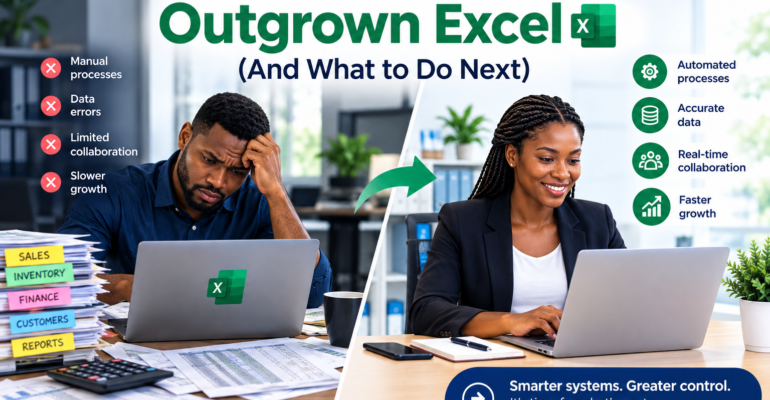
7 Signs Your Business Has Outgrown Excel (And What to Do Next)
 Lagetronix
Outgrow Excel is a phrase many business leaders never expect to hear.
After all, Microsoft Excel is one of the most powerful business tools ever created. It is flexible, familiar, affordable, and widely used.
For startups and small businesses, Excel often works extremely well.
But as organizations grow, something starts to happen.
Spreadsheets multiply.
Versions become harder to track.
Reporting takes longer.
Errors become more expensive.
Employees spend more time updating data than using it.
The issue is not that Excel is bad.
The issue is that many businesses continue using Excel long after they have outgrown Excel.
The result?
- Reduced visibility.
- Operational inefficiencies.
- Poor decision-making.
- Growth bottlenecks.
Companies rarely realize these challenges are linked directly to their systems until the business starts feeling the pain.
Why Businesses Love Excel
Let’s be fair.
Excel remains one of the most effective business tools available.
It can be used for:
- Budgeting
- Forecasting
- Data analysis
- Financial reporting
- Inventory tracking
- Payroll calculations
- Project planning
- KPI reporting
In the early stages of growth, spreadsheets provide flexibility without requiring significant investment.
However, growth changes everything.
The processes that work for a 10-person company often become obstacles for a 100-person company.
What Happens When Businesses Outgrow Excel?
When organizations outgrow Excel, spreadsheets stop being productivity tools and start becoming risk factors.
Leaders begin noticing:
- Increased reporting delays
- Data inaccuracies
- Duplicate work
- Missing information
- Approval bottlenecks
- Lack of visibility
- Employee frustration
The business grows, but decision-making becomes slower.
This is often the first warning sign.
How Real-Time Business Visibility Improves Cash Flow
One of the biggest benefits of real-time business visibility is improved financial control.
When organizations can instantly view receivables, payables, inventory levels, procurement commitments, and operational costs, they gain greater confidence in financial decision-making.
Without real-time business visibility, businesses often discover cash flow issues after they have already affected operations.
Sign #1: Multiple Versions of the Same Spreadsheet Exist
How many versions of your sales report exist?
How many budget files are stored in different folders?
How many employees maintain separate copies of critical data?
If your organization has files named:
- Final Report
- Final Report V2
- Final Report Updated
- Final Report Latest
- Final Report Final Final
You may have already outgrown Excel.
When employees work with different versions of the same information, accuracy becomes difficult to guarantee.
Management meetings become debates about whose numbers are correct.
Instead of making decisions, teams spend time validating data.
Sign #2: Reporting Takes Days Instead of Minutes
Many growing companies devote significant time to preparing reports.
Employees manually:
- Gather information
- Consolidate spreadsheets
- Verify formulas
- Cross-check departments
- Generate summaries
By the time leadership receives the report, the information may already be outdated.
Modern organizations increasingly require real-time access to information, not monthly surprises.
If your reporting process depends heavily on manual spreadsheet consolidation, your business may have reached a point where Excel is limiting visibility.
Sign #3: Inventory Data Is Frequently Wrong
Inventory is one of the first areas where businesses typically outgrow Excel.
As transaction volumes increase, spreadsheets struggle to keep up.
Common symptoms include:
- Inventory shortages
- Excess inventory
- Duplicate purchases
- Missing stock
- Warehouse discrepancies
- Delayed updates
Many organizations only discover inventory issues after they affect customer deliveries or cash flow.
The larger the organization becomes, the harder spreadsheet-based inventory management becomes.
Sign #4: Too Many Employees Depend on One Spreadsheet
In many businesses, there is one spreadsheet nobody wants to touch.
Only one employee understands it.
Only one person knows the formulas.
Only one person can update it correctly.
If that employee is unavailable, the process stops.
This creates operational risk.
Growing organizations require systems that reduce dependency on individual knowledge and increase organizational resilience.
If key business processes depend on specific spreadsheet owners, it may be time to reconsider the approach.
Sign #5: Errors Are Becoming Expensive
A spreadsheet error may seem minor.
Until it affects:
- Payroll
- Procurement
- Inventory
- Sales forecasting
- Customer orders
- Financial reporting
Small spreadsheet mistakes can create significant business consequences.
Examples include:
- Incorrect inventory purchases
- Revenue reporting errors
- Costing mistakes
- Delayed decision-making
- Compliance risks
The larger the business becomes, the higher the financial impact of spreadsheet errors.
Organizations that have outgrown Excel often discover that manual processes create hidden costs throughout the business.
Sign #6: Approvals Are Trapped in Email Threads
Does your organization approve purchases through email?
Do managers manually review requests?
Do employees spend time chasing approvals?
Do approvals disappear in lengthy email conversations?
As businesses grow, manual approval workflows become more difficult to manage.
This creates:
- Delays
- Lost requests
- Reduced accountability
- Poor visibility
Modern organizations increasingly automate approvals, allowing requests to move through structured workflows while maintaining complete visibility and audit trails.
Sign #7: Leadership Cannot See the Business in Real Time
This is often the most serious warning sign.
Can you answer these questions immediately?
- What is our current cash position?
- What inventory is available today?
- Which customers owe us money?
- Which projects are profitable?
- Which products are performing best?
- What approvals are waiting?
Many businesses cannot answer these questions without calling departments and collecting spreadsheets.
When leadership lacks immediate visibility, decision-making becomes reactive rather than proactive.
Organizations that grow successfully often invest in systems that provide a single source of truth across the enterprise.
What Should Businesses Use Instead of Excel?
The answer is not to abandon Excel completely.
Excel still provides tremendous value for analysis and reporting.
The goal is to stop using Excel as a substitute for business systems.
Growing organizations often benefit from:
ERP Systems
ERP platforms help connect:
- Finance
- Sales
- Procurement
- Inventory
- Operations
- Customer Service
- Reporting
Instead of separate spreadsheets, everyone works from the same data source.
Business Intelligence Solutions
Business Intelligence provides:
- Interactive dashboards
- KPI monitoring
- Trend analysis
- Forecasting
- Executive visibility
Decision-makers spend less time gathering information and more time acting on it.
Business Process Automation
Automation helps reduce:
- Manual data entry
- Approval delays
- Repetitive work
- Human error
Organizations become more productive while improving consistency.
The Hidden Cost of Staying on Excel Too Long
Many leaders focus on the cost of implementing new systems.
Few focus on the cost of maintaining outdated processes.
The hidden costs often include:
- Lost productivity
- Delayed decisions
- Inventory inaccuracies
- Cash flow challenges
- Employee frustration
- Customer service issues
- Compliance risks
- Growth limitations
The question is no longer:
“How much will a new system cost?”
The better question is:
“How much is the current process costing the business every month?”
How to Know When It’s Time to Move Beyond Spreadsheets
If your organization is experiencing three or more of the issues below, you may have already outgrown Excel:
- Multiple spreadsheet versions
- Delayed reporting
- Inventory inaccuracies
- Approval bottlenecks
- Heavy manual processes
- Data duplication
- Visibility challenges
- Growth-related operational complexity
The solution does not necessarily require replacing every spreadsheet immediately.
The first step is understanding where the major inefficiencies exist and identifying opportunities for automation and integration.
Conclusion
Excel is one of the greatest business tools ever created.
But it was never designed to manage every aspect of a growing enterprise.
The same spreadsheet processes that help a business start may eventually limit its ability to scale.
Businesses that successfully grow beyond spreadsheets typically experience:
- Better visibility
- Stronger operational control
- Faster reporting
- Improved productivity
- Better decision-making
- Greater scalability
The goal is not to eliminate Excel.
The goal is to ensure your business is no longer constrained by it.
Frequently Asked Questions
How do I know if my business has outgrown Excel?
If you struggle with multiple spreadsheet versions, inventory errors, reporting delays, manual approvals, or limited visibility, your business may have outgrown Excel.
What is better than Excel for growing businesses?
ERP systems, business intelligence platforms, workflow automation solutions, and integrated business applications often provide better scalability than spreadsheet-based processes.
Should businesses stop using Excel entirely?
No. Excel remains valuable for analysis and reporting. However, using spreadsheets as the primary system for managing critical business operations can become risky as the business grows.
When should a company move to an ERP system?
Organizations typically evaluate ERP solutions when spreadsheets can no longer provide the visibility, control, accuracy, and scalability needed to support growth.
Has Your Business Outgrown Excel?
If spreadsheets are slowing down reporting, inventory management, approvals, or decision-making, it may be time to explore a more scalable approach.
Why do businesses outgrow Excel?
Most businesses outgrow Excel when spreadsheets can no longer support the complexity of inventory management, financial reporting, approvals, forecasting, and operational visibility. As the business grows, the need for automation, integration, and real-time information also increases.
What Should Businesses Use Instead of Excel?
Looking Beyond Spreadsheets
Many businesses that outgrow Excel eventually begin exploring integrated business platforms that provide better visibility, automation, and scalability. Solutions such as Microsoft Dynamics 365 Business Central, Sage ERP Solutions, and Business Process Automation Services help organizations eliminate manual processes, improve reporting accuracy, and gain greater operational control.
At Lagetronix Nigeria Limited, we help organizations improve operational efficiency through:
- Microsoft Dynamics 365 Business Central
- Sage ERP Solutions
- Business Process Automation
- Business Intelligence & Analytics
- Microsoft 365 Copilot
- Cloud Solutions
- Digital Transformation Services
The future belongs to organizations that can transform information into action.
Why More Companies Outgrow Excel Every Year
As organizations expand, transaction volumes increase, departments become more connected, and reporting requirements become more complex. This is one of the main reasons businesses outgrow Excel and begin investing in ERP systems, automation platforms, and business intelligence tools that provide greater control and visibility across the organization.
By investing in systems that support real-time business visibility, organizations can improve decision-making, strengthen operational performance, and create a stronger foundation for growth.
The organizations that win tomorrow will be those that can access the right information at the right time and use that information to make confident business decisions.
Ready to Achieve Real-Time Business Visibility?
If your organization still relies on spreadsheets, disconnected reports, and manual processes, now is the time to invest in real-time business visibility.
Lagetronix helps organizations connect finance, operations, sales, inventory, and reporting into a single source of truth using ERP, Business Intelligence, AI, and Modern Workplace solutions.
📧 sales@lagetronix.com
📞 09156503741 | 09165120977 | 02018880031
The most successful businesses are not necessarily the ones with the most data. They are the ones that can use their data most effectively.


